
Auto-tuned gain schedule
A pinch valve changes its restriction nonlinearly across its travel. The controller measures the valve's response across for even control authority with fast response.
aqValve Controller
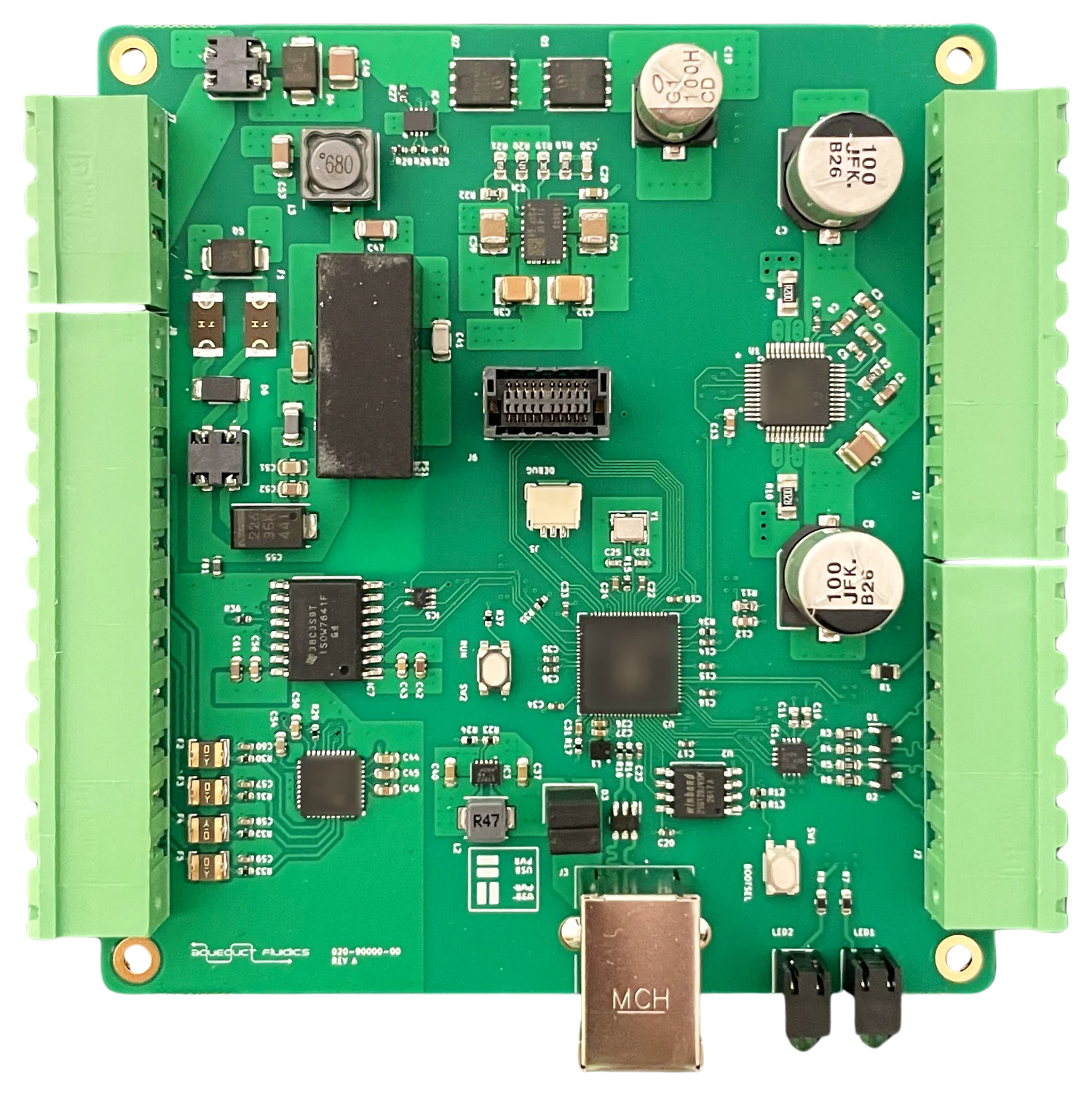
A standalone controller for stepper-motor-actuated proportional pinch valves. Regulate a process from up to four 4–20 mA inputs. An auto-tune scan characterizes each valve and gain-schedules the loop for fast, tight control.
A pinch valve changes its restriction nonlinearly across its travel. The controller measures the valve's response across for even control authority with fast response.
Four isolated, differential 4–20 mA process inputs on a 24-bit ADC for precise pressure or process-variable feedback.
Sensorless stall detection homes any valve, with an optional hall-sensor input for valves that have one.
Tune the stepper drive parameters to match the valve and application.
An optional color touchscreen runs setpoints, monitoring, and calibration for fully standalone operation.
Modbus RTU over RS-485 for integration into larger systems, plus a desktop application over USB for monitoring, configuration, and control.
A proportional pinch valve acts as a tunable flow restriction. Its response is steeply nonlinear; across most of the travel, the tube is barely pinched and the restriction changes very little. However, near the closed position, a small movement sharply increases the restriction. The aqValve controller auto-characterizes the valve and tube with a scan that sweeps the travel and measures the process gain.
Repeatable homing ensures the reliability of the gain schedule. At each power-on, the controller homes to a repeatable reference — using either a Hall sensor or sensorless stall detection — and applies a tunable offset to establish the full-open position. The calibrated full travel is measured from this point, ensuring the same command consistently lands at the same position.
A recorded run engaged control at a 5 psi setpoint, then stepped through 3, 12, and 24 psi and back down through 12 and 2 psi. Pressure, setpoint, and valve position are logged together. On each step the controller feeds forward from the auto-tune's gain curve, moving the valve toward the position it knows produces the new setpoint.
Once settled, control stays steady. Here the loop holds a 5 psi setpoint for 30 minutes: pressure stays within a standard deviation of about 0.009 psi and 0.055 psi peak-to-peak.
Hold transmembrane pressure or permeate pressure precisely throughout a TFF run.
Precisely step transmembrane pressure with crossflow to run excursions that characterize and optimize a TFF process.
Dynamically meter fluid transfer by pairing the valve with real-time feedback from inline mass flow meters or gravimetric weight scales.
Our tangential flow filtration platform: hardware, control, and recipes.
Explore openTFF →Guides, device references, and the Python API for the Aqueduct platform.
Read the docs →Interested in the aqValve Controller for your process? Tell us about your application and we'll follow up.
info@aqueductfluidics.com